


For most one-bag trips, pack three pairs of quick-dry synthetic underwear if you’re headed somewhere hot and humid, or two pairs of merino if you’re doing multi-day travel with limited laundry access. SVBFLOR’s Tri-Pouch™ Boxers cover the synthetic side of that equation. Sink-wash one pair every night and you never run short, no matter how long the trip runs.
TL;DR:
- Synthetic underwear offers the fastest dry times, typically 2 to 6 hours, making it ideal for hot and humid destinations with limited laundry access.
- Merino wool supports multiple re-wears of 2 to 5 days due to its structural odor resistance, suitable for long trips with minimal washing.
- Proper fit, seam construction, and waistband width are crucial for comfort and durability during extended wear, especially in travel conditions.
- Packing 2 to 3 merino pairs or 3 to 5 synthetic pairs is recommended for a week-long trip, depending on laundry frequency and activity level.
- Washing techniques like towel-pressing and air-drying in well-ventilated areas significantly reduce dry time and extend underwear lifespan.
Table of Contents
- Best Underwear for Travel Men, by Use Case
- How to Choose Travel Underwear That Actually Works
- Synthetic vs. Merino vs. Bamboo: What Each Fabric Actually Does
- How to Wash Underwear in a Hotel Sink and Have It Dry by Morning
- How Many Pairs to Pack: 3-Day, 7-Day, and 14-Day Rotations
- Briefs, Boxers, Boxer Briefs, and Trunks: Which Style Travels Best
- Why Moisture-Wicking and Breathability Matter More While Traveling
- Durability: What Actually Wears Out Travel Underwear First
- Packability and Weight: What Underwear Actually Costs You in Carry-On Space
- What Travel Underwear Actually Costs, and What You Get at Each Price Point
- Washing Travel Underwear on the Road Without Ruining It
- Why SVBFLOR Builds Travel Underwear Around Dry Time, Not Just Comfort
- Ready to Pack Smarter for Your Next Trip
- Sources
- FAQ
Best Underwear for Travel Men, by Use Case
The right pair depends less on brand and more on what your trip actually demands from the fabric. A beach trip to Bangkok and a two-week trek through Patagonia put completely different stress on your underwear drawer, and picking based on a generic “best of” list instead of your actual itinerary is how guys end up hand-washing boxers in a sink at 11 p.m. with an early flight.
Hot and humid climates call for synthetic mesh, full stop. Nylon and polyester blends with elastane dry in 2 to 6 hours on a line in moderate humidity, which means a sink wash before dinner is usually dry before you go to sleep. The open-knit panels also move air across skin that’s already dealing with 90-degree heat and sweat. Pack three to four pairs and wash one nightly. You’re never more than a day away from a clean pair, and the fabric shrugs off the kind of humidity that turns cotton into a damp rag by noon.
Active travel and hiking change the calculus toward support and seam placement over pure dry speed. A pouch-style front panel that doesn’t ride up during a scramble matters more than shaving an extra hour off dry time, and flatlock seams along the inner thigh prevent the kind of chafing that ends a hike early. Look for underwear with mesh ventilation panels at the areas that sweat most (typically the sit bones and inner thigh) combined with a snugger, non-slip leg opening. This is one case where a slightly longer dry time is worth trading for a fit that survives a 12-mile day.
Long-haul flights and business travel reward comfort and low bulk over anything else. You’re sitting for 8, 10, sometimes 16 hours, and a thick waistband or a seam that digs in becomes unbearable somewhere around hour six. Trunk-style cuts with a wide, soft waistband and minimal interior seaming tend to hold up best here. Anti-chafe flatlock construction also matters more on a flight than almost anywhere else, since you’re not moving enough to shift a bunched seam away from irritated skin.
Multi-day trips with minimal laundry access are where merino earns its higher price tag. Merino wool’s natural antimicrobial structure resists odor at a fiber level, not through a chemical coating, which lets most men comfortably re-wear a pair for two to five days depending on activity level and climate. That’s the entire appeal for backpackers and business travelers doing a week in one bag: fewer pairs, less washing, no odor creeping out of your dry bag by day four.
Value and budget picks usually mean a multi-pack synthetic option you can throw in a carry-on without thinking twice. A three-pack of moisture-wicking boxer briefs costs less than a single pair of premium merino and covers the basics for shorter trips where re-wear isn’t the priority.
Here’s how the trade-offs stack up:
- Hot/humid destinations: synthetic mesh, 3 to 4 pairs, nightly wash, 2 to 6 hour dry time
- Active travel/hiking: synthetic or merino blend with reinforced pouch and flatlock seams, 2 to 3 pairs
- Long flights/business trips: trunk cut, soft wide waistband, minimal bulk, 2 pairs plus a spare
- Multi-day minimal laundry: merino or high-merino blend, 2 to 3 pairs, wash every 2 to 5 days
- Budget/immediate needs: synthetic multi-pack, 3 to 5 pairs, the lowest cost per pair
SVBFLOR’s Tri-Pouch™ Boxers are built for the synthetic side of this list, aimed at guys who want quick-dry performance without paying merino prices for a trip where re-wear isn’t the main concern.
How to Choose Travel Underwear That Actually Works
Start with how often you can realistically wash and dry a pair, because that single variable decides almost everything else. If you’re changing hotels every night and won’t touch a sink, you need a wash-and-wear travel underwear rotation that leans synthetic. If you’ve got a home base for a week or don’t mind hand-washing in a hostel bathroom, merino’s slower dry time stops being a dealbreaker.
Run through this checklist before you buy anything:
- Dry time. Ask how long the fabric takes to line-dry in average humidity. If the answer is vague marketing copy instead of a number, assume it’s slow.
- Odor resistance. Structural (fiber-level) resistance, like merino’s, holds up over the life of the garment. Chemical treatments on synthetics break down after repeated washing, typically losing effectiveness somewhere between 12 and 18 months of regular use.
- Fit and chafe protection. Check inseam length against your own measurements, look for flatlock or laser-cut seams, and confirm the leg opening has enough grip to stay put without cutting off circulation.
- Durability. Elastane content, stitch density, and fabric weight all affect how many trips a pair survives before the waistband goes slack.
- Price per wear. Divide the cost by how many wears you’ll realistically get between washes and over the garment’s lifespan, not just the sticker price.
The decision flow is simple once you know your wash frequency: daily access to a sink or laundry points you toward synthetic mesh, while washing every 3 to 5 days points you toward merino or a merino blend. Everything else, seam design, pouch construction, waistband width, is about matching the activity level of the trip, not the climate.
Pro Tip: Measure your own inseam before ordering online. A half-inch of extra leg fabric on a boxer brief is the difference between smooth thighs on day one and a raw chafe mark by day three of a walking-heavy trip. Check a sizing guide against your own numbers rather than guessing from a size chart alone.
On the cost-per-wear math: a $25 synthetic pair worn 100 times over its life costs $0.25 per wear. A $40 merino pair worn only 60 times before the elastic gives out costs $0.67 per wear, even though the sticker price felt comparable. Buy for how long the fabric actually lasts, not just what it costs at checkout.
Synthetic vs. Merino vs. Bamboo: What Each Fabric Actually Does
Fiber type and construction directly determine how fast moisture leaves the fabric and how quickly bacteria (the actual source of odor) can build up, according to peer-reviewed textile research. That’s the entire story behind why one pair dries in three hours and another takes half a day.
Synthetic blends (nylon or polyester with elastane) are the fastest-drying option on the market, typically hitting 2 to 6 hours line-dry time in moderate humidity. Their odor resistance comes from a chemical treatment applied during manufacturing, which works well out of the box but fades with washing. Most synthetics lose a noticeable amount of odor control somewhere in the 12 to 18 month range of regular wear.
Merino wool dries far slower, commonly 8 to 12 hours or more, but its odor resistance is structural rather than a coating. The fiber itself resists bacterial buildup, which is why merino handles 2 to 5 days of re-wear in many conditions without smelling. For background on the fiber’s natural properties, Britannica’s overview of wool covers the basics of why animal fibers behave differently from synthetics at a molecular level.
Bamboo and viscose land somewhere in the comfort-to-performance middle. The fabric feels soft against skin and offers moderate odor resistance, with dry times closer to merino than to synthetic mesh.
Blends of merino and synthetic fiber try to split the difference, pulling dry time down closer to synthetic territory while keeping some of merino’s structural odor control.
A quick side-by-side:
- Synthetic mesh: 2 to 6 hour dry time, chemical odor treatment, degrades over 12 to 18 months
- Merino wool: 8 to 12+ hour dry time, structural odor resistance, supports 2 to 5 day re-wear
- Bamboo/viscose: moderate dry time and odor resistance, strong comfort factor
- Merino/synthetic blends: faster drying than pure merino, better odor control than pure synthetic
If sustainability factors into your buying decision, look for wool certified under the Responsible Wool Standard, which sets sourcing and animal-welfare benchmarks that let you evaluate a merino product’s supply chain claims instead of taking a hangtag at face value.
How to Wash Underwear in a Hotel Sink and Have It Dry by Morning
Getting a pair from sweaty to wearable overnight comes down to technique, not luck. This sequence works in almost any hotel bathroom or hostel sink:
- Fill the sink with lukewarm water and add a small amount of travel detergent, roughly a dime-sized drop of liquid or a quarter of a travel sheet.
- Submerge and agitate the fabric by hand for 30 to 60 seconds, focusing on the crotch panel where sweat and bacteria concentrate most.
- Drain and rinse with clean water until no suds remain, usually two rinse cycles.
- Wring firmly, twisting the fabric in opposite directions to push out as much water as the fibers will release.
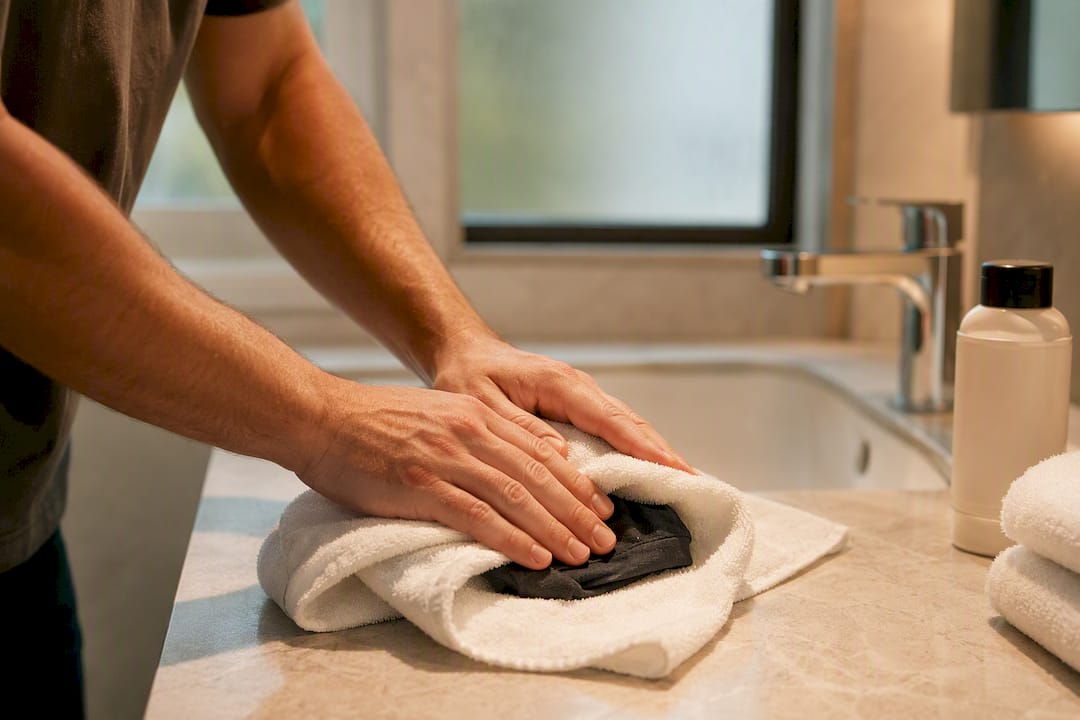
- Towel-press by laying the pair flat inside a dry towel, rolling it tightly, and pressing down with body weight for 15 to 20 seconds. This step alone cuts meaningful time off the total dry cycle compared to skipping straight to hanging.
- Hang somewhere with airflow. A bathroom fan, an open window, or a spot directly under an air-conditioning vent beats a closed closet every time.
Dry-time expectations still track the fabric: synthetic mesh handled this way is typically dry in 2 to 4 hours, while merino needs closer to 8 to 10 hours even with the towel-press shortcut. That gap alone should shape which fabric you pack for a trip with tight morning turnarounds.
Pro Tip: If a hotel room feels humid, run the bathroom fan for ten minutes before hanging anything to wash. Dropping the ambient humidity first shaves real time off whatever you hang afterward.
When a trip runs long enough or laundry access is easy, a hotel laundry service or a laundromat is worth the cost simply to avoid wearing down fabric with daily hand-washing and wringing.
How Many Pairs to Pack: 3-Day, 7-Day, and 14-Day Rotations
Pack count comes down to trip length and wash access, and the math is straightforward once you commit to a fabric. Travel testers generally recommend 2 to 3 merino pairs for multi-day re-wear or 3 to 5 synthetic pairs with nightly washing for one-bag travel, and that range holds up across most trip lengths.
- 3-day trip: 2 merino pairs (wash once, mid-trip) or 3 synthetic pairs (wash nightly)
- 7-day trip: 3 merino pairs (wash every 2 to 3 days) or 4 to 5 synthetic pairs with nightly washing
- 14-day trip: 3 to 4 merino pairs paired with one laundry-service stop, or 5 to 6 synthetic pairs with consistent nightly washing
Fabric choice directly changes how much space and weight your underwear takes up in a carry-on. Merino packs bulkier per pair but needs fewer pairs total, while synthetic packs flatter but multiplies with trip length if you’re not washing nightly.
For lost luggage or unexpected delays, a spare pair stashed in your daypack or laptop bag (rather than checked luggage) means you’re never caught without options for 24 to 48 hours. If you need to store a damp pair temporarily, a mesh laundry bag or a dedicated wet-dry compartment pocket keeps moisture away from dry clothes until you can hang it properly that night.
Briefs, Boxers, Boxer Briefs, and Trunks: Which Style Travels Best
Style matters more for travel than most guys assume, since the wrong cut under a heavy pack or on a long flight creates friction points a normal day at the office never would.
Briefs offer the tightest, most minimal profile and pack the smallest. They work well under athletic gear or compression pants but offer the least thigh coverage, which means less protection from chafing on long walking days.
Boxers give the most airflow and freedom of movement, making them a solid pick for hot climates and lounging in transit. They’re the least likely to trap heat but the most likely to bunch under fitted travel pants.
Boxer briefs split the difference and are the most common recommendation across travel gear roundups. The longer leg provides thigh coverage that cuts down on chafing, while the fitted cut keeps things from bunching under pants.
Trunks run shorter in the leg than boxer briefs but keep the same snug, supportive fit. They’re a strong choice for long-haul flights specifically, since the shorter leg reduces fabric bunching when you’re seated for hours.
Most frequent travelers land on boxer briefs or trunks as their default, reserving briefs for hot-weather trips where minimal coverage matters more than chafe protection, and boxers for casual, low-activity trips where airflow beats structure.
Why Moisture-Wicking and Breathability Matter More While Traveling
Sweat that doesn’t evaporate quickly is what turns a long travel day uncomfortable, and it’s also the direct cause of odor and skin irritation. Moisture-wicking fabric pulls sweat away from skin and spreads it across a wider surface area of fabric, which speeds up evaporation compared to fabric that just absorbs and holds moisture, like standard cotton.
Breathability works alongside wicking by letting air move through the fabric structure itself. Mesh panels, especially at the crotch and sit-bone areas, are the most direct way manufacturers build in airflow, and they matter most in exactly the scenarios travel underwear faces: a hot bus ride, a long walk between train connections, a cramped economy seat with no air moving.
Fiber type shapes both properties. Synthetic mesh wicks moisture fast and dries fast because the fiber itself doesn’t absorb water the way natural fibers do. Merino absorbs more moisture into the fiber but manages the resulting dampness through natural thermoregulation, keeping you from feeling as clammy even though the fabric itself holds more water.
The practical takeaway: if your trip involves a lot of sweating (hiking, humid climates, long walking days) prioritize wicking speed. If it’s mostly sitting (flights, trains, office days on a business trip) breathability and comfort matter more than raw wicking speed, since you’re not generating heavy sweat in the first place.
Durability: What Actually Wears Out Travel Underwear First
The waistband goes before the fabric does, in most cases. Elastane loses stretch with repeated washing and stretching, and daily sink-washing on the road accelerates that breakdown compared to a normal at-home laundry cycle. Look for a wide, structured waistband instead of a thin elastic band. Wider bands distribute stress across more material and typically hold their shape longer.
Seam construction is the second failure point. Standard stitched seams can fray or pop under the repeated stretching that travel abuses (backpack straps rubbing, days of walking, aggressive hand-wringing during a sink wash). Flatlock and laser-cut seams distribute stress more evenly and tend to survive that abuse better than a basic sewn seam.
Fabric weight and density also matter more for travel than for everyday wear. A lightweight, loosely woven synthetic dries fast but can develop small holes or thin spots faster under repeated hand-washing and wringing. A slightly denser weave sacrifices a bit of dry speed for a longer usable life.
Outdoor gear testing protocols commonly track construction quality, particularly seam work, as a core rating factor alongside dry time and comfort, which tells you seams aren’t a minor detail; they’re one of the main things separating gear that lasts a season from gear that lasts three trips.
Packability and Weight: What Underwear Actually Costs You in Carry-On Space
Travel underwear is small, but multiply any fabric choice by five or six pairs and the space adds up fast in a carry-on that’s already tight on room.
Synthetic mesh compresses the smallest of any fabric type, since the open-knit construction has less bulk to begin with. A pair typically rolls down to about the size of a golf ball, which makes packing five or six pairs a non-issue even in a 20-liter daypack.
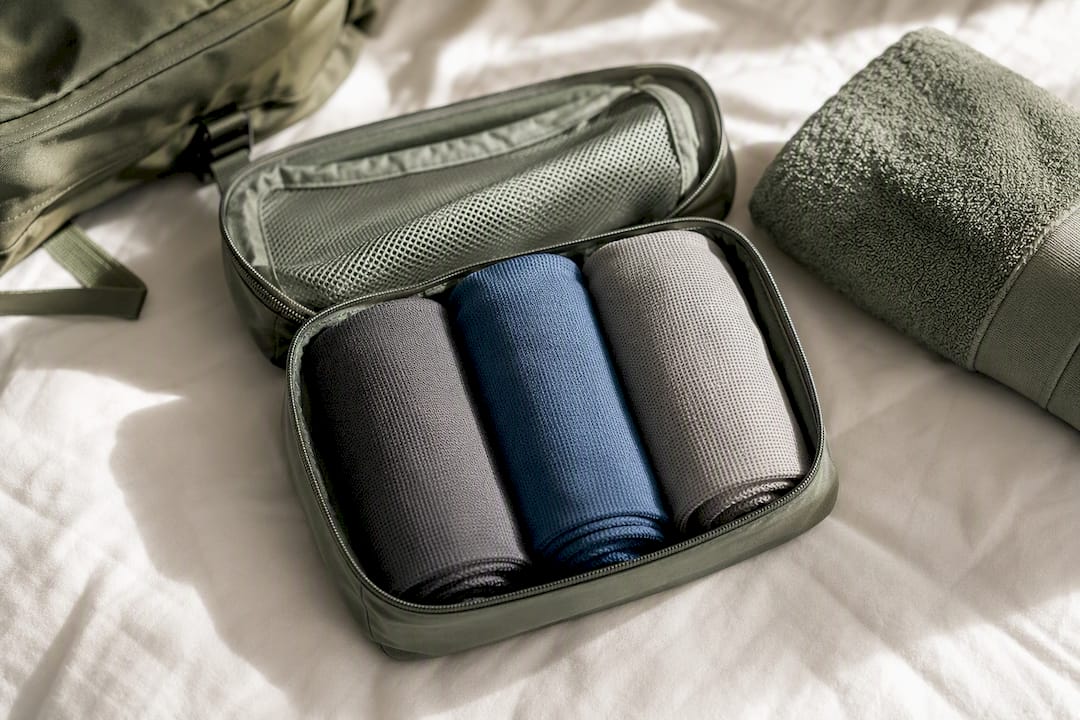
Merino runs heavier and bulkier per pair, since the fiber itself has more mass and the knit tends to be denser for durability. That’s part of why the packing math favors fewer merino pairs. You’re not just trading wash frequency for comfort, you’re also trading pack volume.
Packing cubes help regardless of fabric choice by compressing everything into a fixed shape, but the honest weight-saving move is simply choosing fewer, better pairs over a large stack of backups. Three pairs of quality synthetic underwear, washed nightly, take up less space and weigh less than five pairs of a heavier fabric bought “just in case.”
What Travel Underwear Actually Costs, and What You Get at Each Price Point
Budget synthetic multi-packs run on the low end, typically landing well under $15 per pair when bought in a three-pack or larger. That price point gets you basic moisture-wicking performance and reasonable durability for occasional travel, but usually skips features like reinforced seams or odor-specific treatments.
Mid-range synthetic and blend options, including performance-focused brands, generally run $20 to $30 per pair. SVBFLOR’s Tri-Pouch™ Boxers sit in this range at $59 (check current pack pricing on the underwear collection page), built around a pouch-style front panel and moisture-wicking fabric aimed specifically at active and travel use rather than everyday basics.
Premium merino and merino-blend pairs typically run $30 to $45 per pair, reflecting both the cost of the raw fiber and the manufacturing complexity of working with wool at a performance-fabric weight. The insight worth internalizing here: frequent travelers tend to weigh dry time and re-wear math over sticker price, because a $40 pair that lets you skip two days of washing on a business trip often beats three $15 pairs that need nightly laundry you don’t have time for.
Value comes down to matching spend to actual trip frequency. Occasional travelers get fine mileage from budget synthetic packs. Frequent travelers, especially those doing multi-day trips with limited laundry access, generally get more real-world value out of paying up for merino or a premium performance blend.
Washing Travel Underwear on the Road Without Ruining It
Hotel sinks and travel-sized detergent sheets are the backbone of on-the-road care, but a few habits protect the fabric over the life of a trip. Use a small amount of dedicated travel detergent rather than hotel bar soap or shampoo, both of which can leave residue that irritates skin on fabric worn directly against it.
Avoid wringing synthetic mesh too aggressively. The open-knit structure that makes it dry fast is also more prone to stretching out of shape under hard twisting. A firmer wring works fine for merino, which holds its shape better under pressure.
Skip the hotel iron and any high-heat drying method entirely. Elastane, the stretch fiber in nearly every pair of travel underwear, breaks down under sustained heat, which is part of why a hair dryer on high, held close to the fabric, will shorten the garment’s life even though it speeds up drying in the moment. Air drying, helped along by a towel-press, remains the safest method regardless of fabric.
If you’re doing a genuinely long trip, rotate in an occasional hotel laundry or laundromat cycle instead of relying entirely on hand-washing. Machine washing on a gentle, cold cycle is actually less abrasive on fabric fibers than daily hand-wringing, even though it feels like the rougher option.
Why SVBFLOR Builds Travel Underwear Around Dry Time, Not Just Comfort
SVBFLOR started from a simple frustration: most men’s basics are designed for a laundry room, not a carry-on. That shows up in the details. The Tri-Pouch™ Boxers use a pouch-style front panel for support and moisture-wicking fabric that prioritizes fast dry time over marketing claims about “all-day comfort” that never get tested against an actual sink wash.
Karina Cartwright, who covers performance apparel and travel gear for SVBFLOR, has spent years evaluating how fabric claims hold up against real wear conditions rather than lab specs alone. Her take: most underwear is designed for how it feels new, not how it performs on day nine of a trip with no laundry in sight.
SVBFLOR’s construction choices reflect that priority: flatlock seams to reduce chafe on long travel days, moisture-wicking synthetic blends built for repeated sink-washing, and a fit engineered to hold its shape after dozens of hand-wash cycles rather than just the first few. If your trip involves nightly hand-washing and an early flight the next morning, that’s the exact use case the Tri-Pouch™ design was built to survive.
Choose it specifically when your trip leans toward hot climates, active days, or tight laundry windows, where dry-by-morning performance matters more than any other single feature.
— Karina Cartwright
Ready to Pack Smarter for Your Next Trip
SVBFLOR built the Tri-Pouch™ Boxers specifically around the problem this article just walked through: fast dry time, chafe-resistant seams, and a fit that survives repeated sink-washing on the road. That’s a different design brief than everyday underwear trying to double as travel gear, and it shows in the details, from the moisture-wicking fabric to the pouch-style support panel.
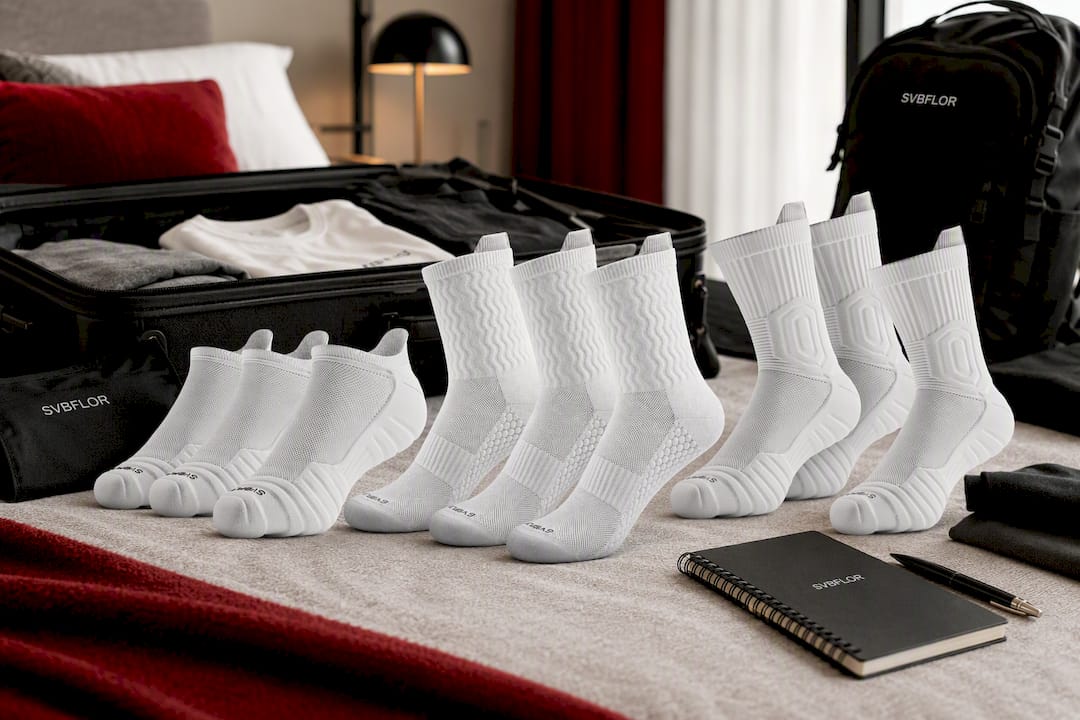
If your next trip involves hot weather, long flights, or laundry you’ll be doing in a hotel sink, the Tri-Pouch™ Boxers collection is built for exactly that. Not sure on sizing? Check the men’s sizing guide before you order, and consider grabbing the SVBS Boxers 3-pack if you’re packing for a longer trip and want backups ready to go. While you’re outfitting your travel drawer, the RaceKnit™ Ultralight Cooling Crew Socks pair naturally with quick-dry underwear for the same nightly wash-and-wear routine. Order now and have your travel basics sorted before your next departure date.
Sources
- PMC article on textiles and microbial growth
- Smartwool Active Merino Review | Tested & Rated
- Responsible Wool Standard (Textile Exchange)
- 12 Best Travel Underwear (September 2026): Expert-Tested Picks
FAQ
What Is the Best Underwear for Men to Wear While Traveling?
Synthetic mesh blends are the best all-around pick for most travel because they dry in 2 to 6 hours and handle nightly sink-washing well. For multi-day trips with limited laundry access, merino wool is the stronger choice since its odor resistance supports 2 to 5 days of re-wear between washes.
What Underwear Should I Wear on a Long-Haul Flight?
Trunk-style or boxer-brief cuts with a soft, wide waistband and flatlock seams work best for long flights, since you’re seated for hours and want to avoid any seam or elastic digging in. Low-bulk synthetic fabric also helps you stay comfortable without overheating in a cramped economy seat.
Is There Such a Thing as Disposable Travel Underwear?
Disposable underwear exists mainly as a backup option for very short trips, medical travel, or emergency situations where washing isn’t possible at all, typically made from lightweight nonwoven fabric meant for one or two wears before disposal. For any trip longer than a few days, reusable quick-dry underwear like synthetic mesh or merino is the more practical and cost-effective option.
How Many Pairs of Underwear Should I Pack for a Week-Long Trip?
For a 7-day trip, pack 3 merino pairs if you can wash every 2 to 3 days, or 4 to 5 synthetic pairs if you’re washing nightly. The right number depends entirely on how often you’ll realistically have access to a sink or laundry.
What Do Americans Call a Bra?
In American English, “bra” is the standard everyday term, short for brassiere, which is the more formal or old-fashioned version of the same word. Both terms refer to the same garment, but “bra” is what you’ll hear in nearly all casual and retail contexts across the United States.

